

Rendering Technical Diagrams & Blueprints
Initializing vector schematics, boundary elevation math, and high-resolution assets...

Dolby Atmos revolutionized cinematic audio by transitioning from channel-based bed tracks to object-based spatial audio. Instead of assigning sounds to fixed speakers, audio engineers position sound objects in a three-dimensional coordinate sphere (X, Y, Z). However, marketing shortcuts—specifically 'Dolby Atmos enabled' upfiring speaker toppers and all-in-one Atmos soundbars—have created widespread disappointment. Many enthusiasts invest in these setups only to wonder why they cannot discern rain falling from above or helicopters flying overhead.
The culprit is acoustic physics: relying on specular sound reflection off residential ceilings is inherently compromised. To experience authentic three-dimensional spatial envelopment, discrete physical ceiling speakers are essential—and moving from a 2-speaker overhead setup (5.1.2) to a 4-speaker layout (5.1.4) fundamentally transforms the listening experience.
Dolby Atmos 'Enabled' upfiring speakers (whether integrated into front towers or mounted as topper modules) attempt an acoustic sleight of hand: they project sound upward at a ~20-degree angle, attempting to bounce sound off the ceiling down toward the primary listening position (PLP).
In laboratory conditions with an ideal 8-foot flat, non-porous gypsum drywall ceiling, this can produce a mild illusion of height. However, in domestic living rooms and media dens, real-world acoustics routinely shatter this illusion:
• Ceiling Texture & Material Absorption: Popcorn plaster, acoustic tiles, wooden tongue-and-groove planks, coffered beams, and drop ceilings scatter or absorb high frequencies. The crucial 7kHz–12kHz Head-Related Transfer Function (HRTF) spectral notch that our brains use to perceive elevation gets scrambled, resulting in muffled, diffused sound rather than a localized overhead object.
• Ceiling Height & Inverted Square Law: Sound must travel up to the ceiling (8–12 feet) and back down to the couch (another 10–14 feet). By the time the reflected wave arrives, it has lost significant acoustic energy (typically -6dB to -10dB SPL) compared to the ear-level speakers, making height cues inaudible unless artificially boosted.
• The Strict Focal Sweet Spot Problem: Angle of incidence equals angle of reflection. If your couch is situated 11 feet away but the bounce geometry lands at 8 feet (onto your coffee table) or 14 feet (behind your head), the height sound completely misses your ears. If you lean forward or recline, the Atmos illusion collapses entirely.
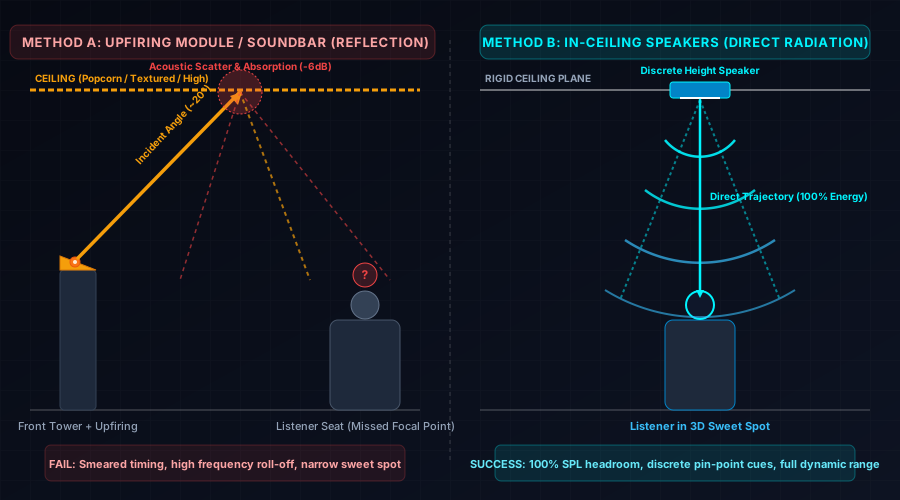
Discrete overhead height speakers—either recessed in-ceiling speakers or ceiling-mounted down-firing elevation modules—completely bypass the unpredictability of ceiling reflection physics.
By establishing an unhindered direct line of sight between the speaker driver and the listener's ears, discrete height speakers deliver three critical advantages:
1. Zero Phase Smear & Time-of-Arrival Precision: Direct sound waves arrive with instantaneous transient attack. When an overhead explosion detonates in a movie, the wavefront strikes your ears at the exact millisecond calculated by your AVR's calibration DSP (Audyssey MultEQ-XT32, Dirac Live, or YPAO).
2. Full Dynamic Range & Bass Extension: Upfiring modules use tiny 3-inch or 4-inch drivers in miniature plastic enclosures that struggle to produce energy below 180Hz. Quality in-ceiling speakers feature 6.5-inch or 8-inch woofers capable of linear response down to 55Hz–70Hz, allowing a clean 80Hz THX crossover to the subwoofer.
3. Consistent Room-Wide Coverage: Wide-dispersion in-ceiling speakers (especially those with pivoting tweeters angled toward the listening area) create a uniform acoustic sweet spot spanning multiple couch seats, rather than a fragile 6-inch sweet spot.
A common dilemma when planning an Atmos setup is choosing between two overhead speakers (.2) and four overhead speakers (.4).
A 5.1.2 setup (featuring two Top Middle ceiling speakers positioned slightly in front of or directly above the listening position) is the minimum entry point for genuine Atmos. It introduces vertical height dimension: rain sounds like it is falling from above, and ambient thunder feels elevated.
However, a 5.1.2 system is fundamentally a two-dimensional height plane. It has left-to-right overhead separation, but ZERO front-to-back overhead depth. When a fighter jet in Top Gun: Maverick or an arrow in Dune streaks from in front of the screen, across the room, and behind your head:
• In a 5.1.2 setup, the sound cannot pan smoothly across the ceiling. It jumps from the front soundstage, flares momentarily in the top-middle speakers, and collapses abruptly into the surround channels.
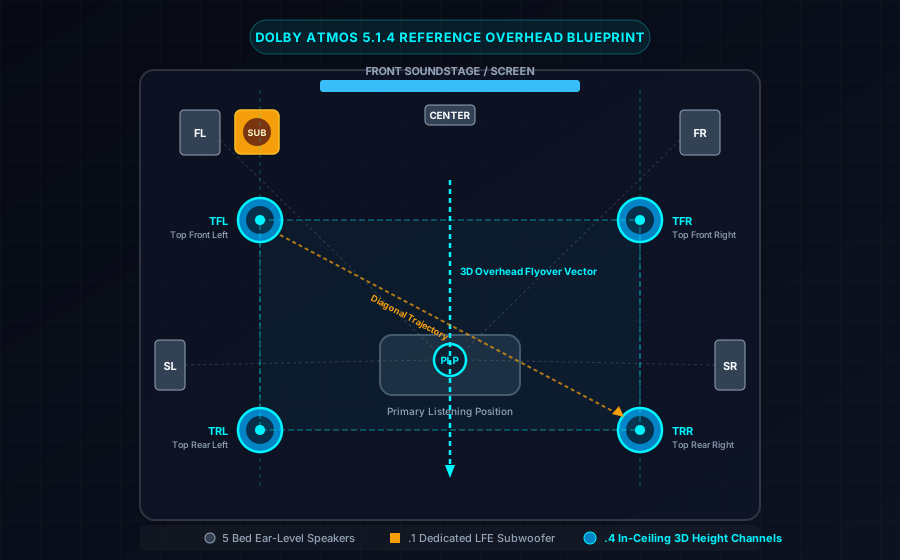
• In a 5.1.4 setup (Top Front Left/Right + Top Rear Left/Right), the AVR creates a true 2x2 overhead coordinate matrix. The sound object glides continuously from front speakers to Top Front, through the overhead canopy, into Top Rear, and seamlessly down into the rear surrounds. This continuous overhead vector is the true magic of cinema spatial audio.
| Metric | Upfiring / Soundbar | 5.1.2 In-Ceiling | 5.1.4 In-Ceiling (Reference) |
|---|---|---|---|
| Acoustic Delivery | Specular Ceiling Bounce | Direct Line-of-Sight | Direct Line-of-Sight (x4) |
| Overhead Channels | 2 Simulated (Diffuse) | 2 Discrete (Top Middle) | 4 Discrete (Top Front + Top Rear) |
| Front-to-Back Panning | None (Collapsed) | None (Static Height) | Seamless 3D Vector Interpolation |
| Frequency Response | ~180Hz - 15kHz (Choked) | 65Hz - 22kHz (Full Body) | 50Hz - 25kHz (Cinema Spec) |
| Ceiling Dependency | Extremely High (Fails) | Zero (Independent) | Zero (Independent) |
| AVR Channel Req. | 7 Channels (Entry) | 7 Channels (Standard) | 9 Channels Amplified (Mid/High Tier) |
| Immersion Score (1-10) | 4 / 10 | 7.5 / 10 | 10 / 10 (True Cinema Reference) |
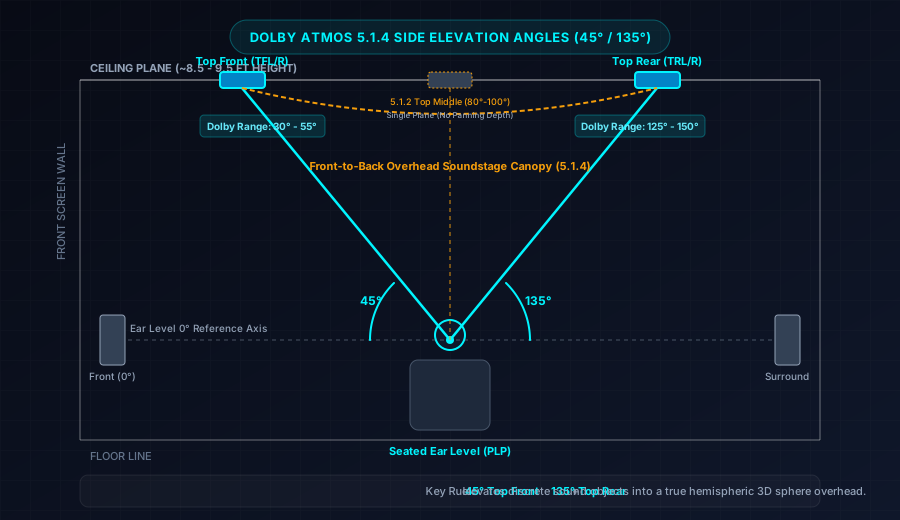
Installing four in-ceiling speakers requires adhering strictly to Dolby's angular specifications to ensure seamless timbral transitions between ear-level speakers and height channels:
• Top Front Speakers (TFL & TFR): Positioned at an elevation angle of 30° to 55° (45° is optimal) in front of the primary listening position (PLP).
• Top Rear Speakers (TRL & TRR): Positioned at an elevation angle of 125° to 150° (135° is optimal) behind the PLP.
• Lateral Width Alignment: The left-to-right spacing of the in-ceiling speakers should align directly with your Front Left and Front Right speakers (typically 0.5x to 0.7x of room width). This preserves a coherent soundstage boundary when objects lift off the screen into the room.
Running a 5.1.4 Dolby Atmos layout requires an Audio/Video Receiver (AVR) with at least 9 channels of onboard amplification and 9-channel processing capability (5 ear-level + 1 sub + 4 height channels = 10 total channels, with the subwoofer powered independently).
Key hardware considerations:
• AVR Recommendations: Modern 9-channel receivers such as the Denon AVR-X3800H, Marantz Cinema 50, Onkyo TX-RZ50, or Yamaha RX-A6A handle full 5.1.4 processing natively with advanced room correction (Dirac Live or Audyssey MultEQ-XT32).
• Bass Management & Crossover: In your AVR setup menu, configure all in-ceiling height speakers as 'Small' and set their crossover filter to 80Hz (for 6.5"–8" woofers) or 100Hz (for 5.25" compact models). Never run ceiling speakers full-range; let your dedicated subwoofer handle heavy low-frequency effects.
• Timbre Matching: For seamless pans from floor to ceiling, ensure your in-ceiling speakers feature tweeter materials compatible with your main front speakers (e.g. silk dome with silk dome, or aluminum dome with metal drivers) to prevent tonal shifts during flyover effects.
While upfiring Atmos speakers and soundbars offer convenient retail plug-and-play marketing, they cannot overcome the laws of domestic room acoustics. Texture, ceiling height, and acoustic absorption invariably degrade the reflected sound. Discrete in-ceiling speakers represent the true architectural foundation of immersive cinema sound. While a pair of ceiling speakers (5.1.2) introduces vertical height, stepping up to a 5.1.4 system with four overhead channels unlocks the full, uncompromised three-dimensional panning canvas that cinema sound designers intended.
A masterclass on designing a seamless, wire-free TV feature wall and floating acoustic media console with disc...
Why upgrading from entry-level boomy subs like the Yamaha YST-SW315 to the sealed SVS SB-1000 Pro delivered ea...